Aegiq, in collaboration with EPCC University of Edinburgh, University of Massachusetts Amherst and Oak Ridge National Laboratory, announces their latest research on arXiv demonstrating a new pathway to efficiently represent fluid dynamics data with physics informed compression using quantum-inspired methods.
The problem: Fluid dynamics requires large datasets
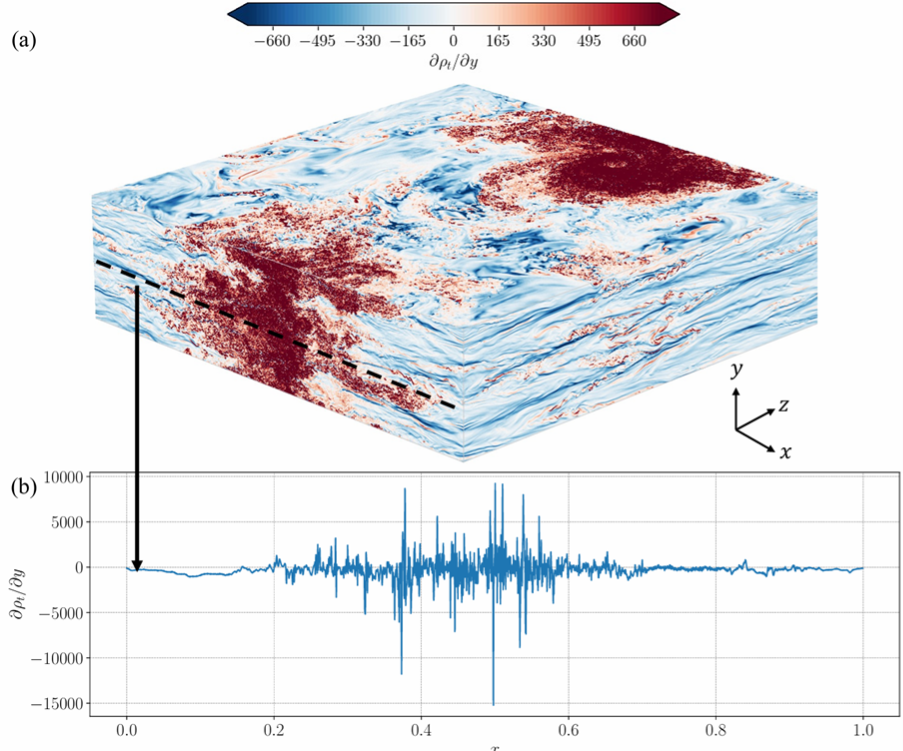
Modern computational fluid dynamics (CFD) is pushing the limits of high-performance computing, including available memory for storage. Today’s simulations produce hundreds of terabytes of data. An example of data from modelling a complex and uneven fluid flow generated in prior work by Aegiq’s UMass Amherst collaborators is shown below (the colours represent how density changes vertically in the flow). In this example, each parameter requires ~275 gigabytes for each snapshot in time.
How does compression with tensor networks work?
Tensor networks originated in quantum physics as a way to efficiently represent quantum many-body systems when entanglement is pre-dominantly short-range, between nearby rather than distant particles, allowing vast amounts of information to be compressed without significant loss. Turbulent fluid dynamics shares a similar mathematical structure: due to the energy cascade the dominant interactions are also short-range, driven by the stepwise transfer of energy from large eddies down to small ones. This makes tensor networks a natural fit for modelling turbulence.
“Big whirls have little whirls
which feed on their velocity,
and little whirls have lesser whirls
and so on to viscosity.”
- Poem by Lewis F. Richardson about turbulence
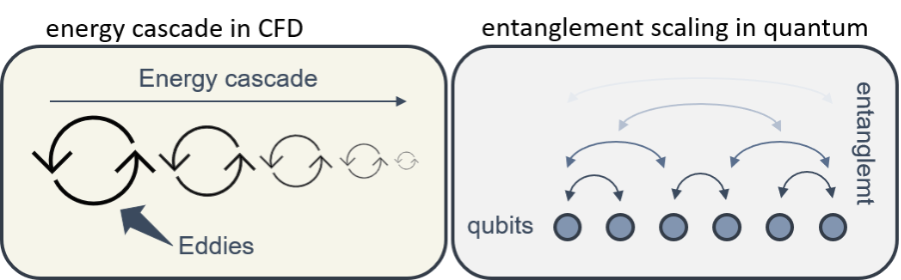
In our pioneering work, we develop the core foundations for the use of tensor networks to compress and manipulate CFD data efficiently. By encoding a 1D fluid data in a tensor network, the team were able to show significant 10x lossless compression and performed computations directly in the compressed form to deliver significant benefit on classical computing systems today.
Potential impact of the foundation developed
Beyond classical simulation, the compression of CFD data into an efficient tensor network representation provides a pathway to future quantum computing. Tensor networks can be efficiently encoded into quantum states via well-established methods, offering a viable route for reading fluid data into future fault tolerant quantum computers.
Aegiq’s approach is not just advantageous for compression, it enables computation directly in compressed form. As an example, we show that nonlinear operations that are expensive to scale, such as the convolution used extensively in CFD solvers, can be performed directly on the compressed data with orders of magnitude speedup over standard fast Fourier transform (FFT)-based methods at large scale. The larger the simulation, the greater the advantage tensor network approaches bring over classical methods.
Looking ahead, Aegiq is already working on extensions from 1D to 2D and 3D fluid data, as well as optimising to run on HPC GPU resources, including ORNL’s Frontier system. In parallel, the framework also enables the testing of different encodings of tensor networks, both in topology and ordering of data, allowing encodings to be tuned for specific problems.
Discovering efficient tensor network encodings plays a key role in advancing Aegiq’s quantum-ready solutions for non-linear PDE acceleration and our goal of making previously intractable problems manageable in areas as diverse as aerospace, fusion plasma modelling and climate simulation.